



MegaMatcher SDK
Large-scale AFIS and multi-biometric identification
MegaMatcher is designed for large-scale AFIS and multi-biometric systems developers. The technology ensures high reliability and speed of biometric identification even when using large databases.
Available as a software development kit that allows development of large-scale single- or multi-biometric fingerprint, iris, face, voice or palm print identification products for Microsoft Windows, Linux, macOS, iOS and Android platforms.
Features and Capabilities
- Proven in national-scale projects, including passport issuance and voter deduplication.
- NIST MINEX-compliant fingerprint engine, NIST IREX proven iris engine.
- Turnkey multi-biometric solution for national-scale identification projects with MegaMatcher ABIS.
- High performance matching for large-scale systems with MegaMatcher Accelerator.
- Fingerprints, irises and faces can be matched on smart cards using MegaMatcher On Card.
- Includes fingerprint, iris, face, voice and palm print modalities.
- Rolled, flat and latent fingerprint matching.
- BioAPI 2.0 and other ANSI and ISO biometric standards support.
- ICAO requirements compliancy check for face images.
- MOSIP compliancy ensures seamless integration with other systems.
- Effective price/performance ratio, flexible licensing and free customer support.
MegaMatcher technology for large-scale Automated Biometric Identification Systems was introduced in 2005. Since that time the technology has been constantly improved with more than 10 major and minor versions released to date.
MegaMatcher technology is available as multiplatform SDK, which includes fingerprint, facial, speaker, iris and palm print recognition engines along with a fused algorithm for fast and reliable identification in large-scale systems. The biometric software engines are based on deep neural networks and contain many proprietary algorithmic solutions that are especially useful for large-scale identification problems. Some of these solutions are listed in the fingerprint, face, voice and iris biometric identification engine descriptions below.
MegaMatcher fingerprint template extraction and matching engine
- Full MINEX Compliance. NIST has recognized MegaMatcher fingerprint algorithm as MINEX compliant and suitable for use in personal identity verification (PIV) program applications.
- Rolled and flat fingerprints matching. The MegaMatcher fingerprint engine matches rolled and flat fingerprints between themselves. Typically, conventional "flat" fingerprint identification algorithms perform matching between flat and rolled fingerprints less reliably due to the specific deformations of rolled fingerprints. MegaMatcher allows flat-to-flat, flat-to-rolled or rolled-to-rolled fingerprint matching with a high degree of reliability and accuracy. The algorithm matches up to 200,000 flat fingerprint records per second on a single PC.
- MegaMatcher includes fingerprint image quality determination, which may be used during enrollment to ensure that only the best quality fingerprint template will be stored in the database. The image quality determination can tell if a finger is too wet, too dry, pressed too much or not enough, or if only tips of fingers are present.
- Spoof fingerprint detection. A deep learning based scanned fingerprint image classification is used to separate live/non-live fingerprints to detect finger presentation attack. This feature covers spoofing attempts performed with ecoflex, wood glue, latex and gelatin and is useful for fraud identification.
- Finger anomaly detection. A spcialized module identifies issues in four-finger scan images, like detecting common errors or fraudulent activities, including scanning footprints instead of hands or incorrect parts of the hand.
- Contactless fingerprints capture. MegaMatcher SDK includes a specialized component that allows to enable seamless and contactless fingerprint capture using a smartphone camera. The component can process photos of four-finger slaps, usually taken with a smartphone camera in a typical environment, and use the processed data for further segmentation and fingerprint template extracton. End-users can benefit from this alternative to traditional fingerprint readers by using their existing smartphones for biometric capture, eliminating the need for a specialized device.
- MegaMatcher is tolerant to fingerprint translation, rotation and deformation. It uses a proprietary fingerprint matching algorithm that identifies fingerprints even if they are rotated, translated or have deformations. Also, the matching algorithm has a special mode for matching different scale fingerprint records, as well as optional matching of mirrored fingerprints.
- Adaptive image filtration algorithm eliminates noises, ridge ruptures and stuck ridges, and reliably extracting minutiae from even the poorest quality fingerprints in less than 1 second.
MegaMatcher face template extraction and matching engine
- Tolerance to face position assures a level of enrollment convenience. MegaMatcher allows for 360 degrees of head roll. Head pitch can be up to 15 degrees in each direction from the frontal position. Head yaw can be up to 45 degrees in each direction from the frontal position. See technical specifications for more details.
- Reliable face detection assures accurate enrollment from cameras, webcams and various scanned documents; faces may be enrolled from the scanned pages of passports or other types of documentation. When there are multiple faces present in a video or an image, they may be enrolled and processed simultaneously. Person's gender and facial feature points can be optionally detected. Also, partially occluded faces (i.e. persons wearing face masks or respirators) can be recognized without separate enrollment.
- Facial attributes recognition. MegaMatcher can be configured to detect certain attributes during the face extraction – smile, open-mouth, closed-eyes, glasses, dark-glasses, beard and mustache.
- Age estimation. MegaMatcher can optionally estimate person's age by analyzing the detected face in the image.
-
Face liveness detection.
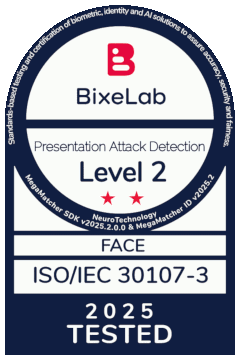
Certified algorithm for face liveness checkA conventional face identification system can be tricked by presenting a photo or wearing a mask with a printed face of another person. MegaMatcher is able to prevent this kind of security breach by determining whether a face in a video stream or single frame is "live" or somehow faked. The liveness detection can be performed in passive mode, when the engine evaluates certain facial features, and in active mode, when the engine evaluates user's response to perform actions like blinking or head movements. See recommendations for face liveness detection for more details.
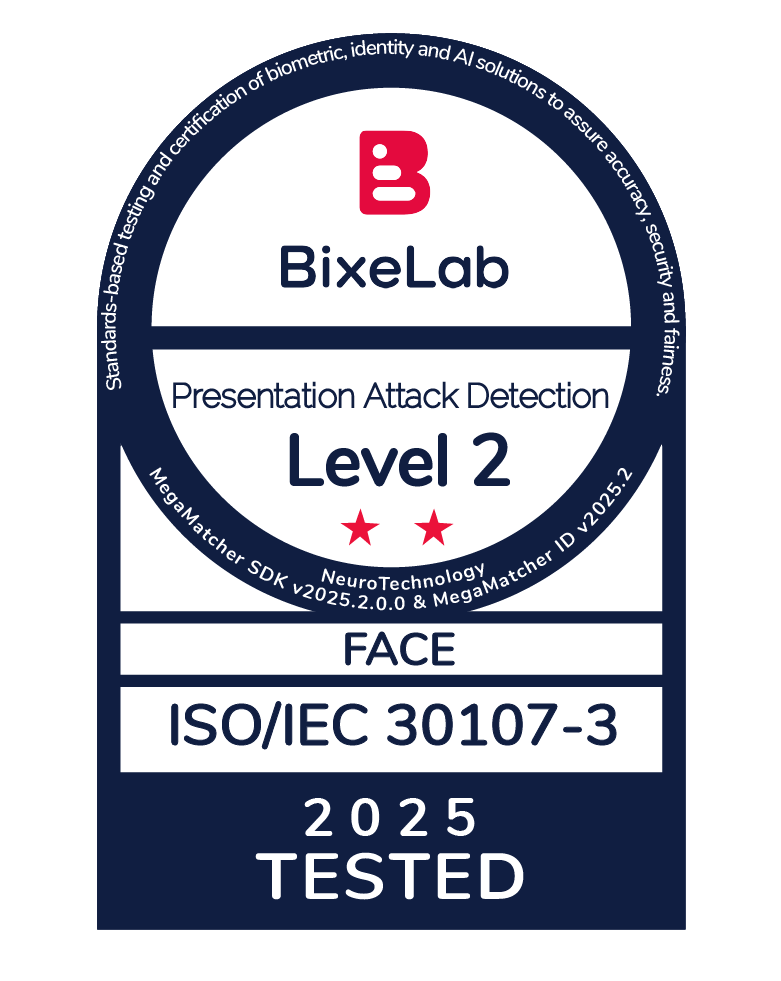
Letter of confirmation from BixeLab - Face morph detection. A specialized module can assess whether a face image is genuine or has been altered by blending features from two or more individuals. This verification helps prevent various security threats, such as document fraud or attempts to bypass biometric access control systems.
- The biometric template record can contain several face samples belonging to the same person. These samples can be enrolled from different sources and at different times, thus allowing improvement in user experience during matching. For example a person might be enrolled with eyeglasses and without, or with different types of eyeglasses; with and without beard or mustache, etc.
MegaMatcher voice template extraction and matching engine
- Text-dependent voice matching engine determines if a voice sample matches the template that was extracted from a specific phrase. During enrollment, one or more phrases are requested from the person being enrolled. Later that person may be asked to pronounce a specific phrase for verification. This method assures protection against the use of a covertly recorded random phrase from that person.
- Two-factor authentication with a passphrase is performed when a person is asked to say a unique phrase (such as passphrase or an answer to a "secret question" that is known only by the person being enrolled). The overall system security increases as both voice authenticity and password are checked.
- Text-independent voice matching engine uses different phrases for user enrollment and recognition. This method is more convenient, as it does not require each user to remember the passphrase. It may be combined with the text-dependent algorithm to perform faster text-independent search with further phrase verification using the more reliable text-dependent algorithm.
- Automatic voice activity detection. The engine is able to detect when users start and finish speaking.
- Liveness detection. A system may request each user to enroll a set of unique phrases. Later the user will be requested to say a specific phrase from the enrolled set. This way the system can ensure that a live person is being verified (as opposed to impostor who uses voice recording).
- Several voice records with the same phrase may be stored to improve speaker recognition reliability. Certain natural voice variations (i.e. hoarse voice) or environment changes (i.e. office and outdoors) can be stored in the same template.
MegaMatcher iris template extraction and matching engine
- NIST IREX proven reliability. MegaMatcher iris matching engine is based on VeriEye, recognized by NIST as one of the most reliably accurate iris recognition algorithms available.
- Fast matching. The iris matching speed is up to 200,000 comparisons per second on a single PC. See technical specifications for more details.
- Robust iris detection. Irises are detected even when there are obstructions to the image, visual noise and/or different levels of illumination. Lighting reflections, eyelids and eyelashes obstructions are eliminated. Images with narrowed eyelids or eyes that are gazing away are also accepted.
- Automatic interlacing detection and correction results in maximum quality of iris feature templates from moving iris images.
- Correct iris segmentation is obtained even when perfect circles fail, the centers of the iris inner and outer boundaries are different, iris boundaries are definitely not circles and even not ellipses or iris boundaries seem to be perfect circles.
- Iris image quality determination. The image quality estimation can be used during iris enrollment to ensure that only the best quality iris template will be stored into database. Roll angle can be determined from iris image for further decisions about accepting the image for enrollment. Also, irises, which are obscured by cosmetic (decorative) contact lenses with some artistic images or color change, can be rejected from enrollment.
- Liveness detection. A captured iris can be analyzed whether it is "live" or a spoof to prevent security breach performed by placing a photo in front of the camera or wearing contact lenses with fake iris texture.
- Automatic iris position detection. The algorithm is able to separate images of left and right irises.


