



FastCAP Qualification
These comments provided by Neurotechnology are based on the NIST Fast Capture (FastCAP) program page, last reviewed on November 3, 2026.
On September 18, 2026, NIST listed Neurotechnology among the vendors whose contactless fingerprint capture technology completed Phase One qualification testing of the NIST Fast Capture (FastCAP) program. The technology met the requirements of NIST Special Publication 500-339, Specification for Certification Testing of Contactless Fingerprint Acquisition Devices. The technology uses a standard smartphone camera to capture all 10 fingerprints in either a supervised or unsupervised environment.
What is NIST FastCAP?
The Fast Capture (FastCAP) program is run by the NIST Biometric Technologies Group in cooperation with industry under Cooperative Research and Development Agreements (CRADA). Over the course of Phase One, NIST worked with participating vendors to evaluate biometric acquisition capabilities, refine performance metrics and test contactless rapid tenprint capture solutions. According to NIST, the completion of these tests provides a baseline of the current state-of-the-art capabilities for rapid identity capture hardware and software solutions, and the results will inform future evaluation metrics, documentation updates and upcoming program milestones. NIST plans to facilitate the adoption of these technologies and to expand its qualification testing model into an ongoing testing framework.
Vendors whose technologies met the requirements of NIST Special Publication 500-339 are listed on the program page. The qualification is based on NIST SP 500-339, which NIST describes as a basis for a future certification pathway for contactless fingerprint capture devices. See the NIST FastCAP program page for more information.
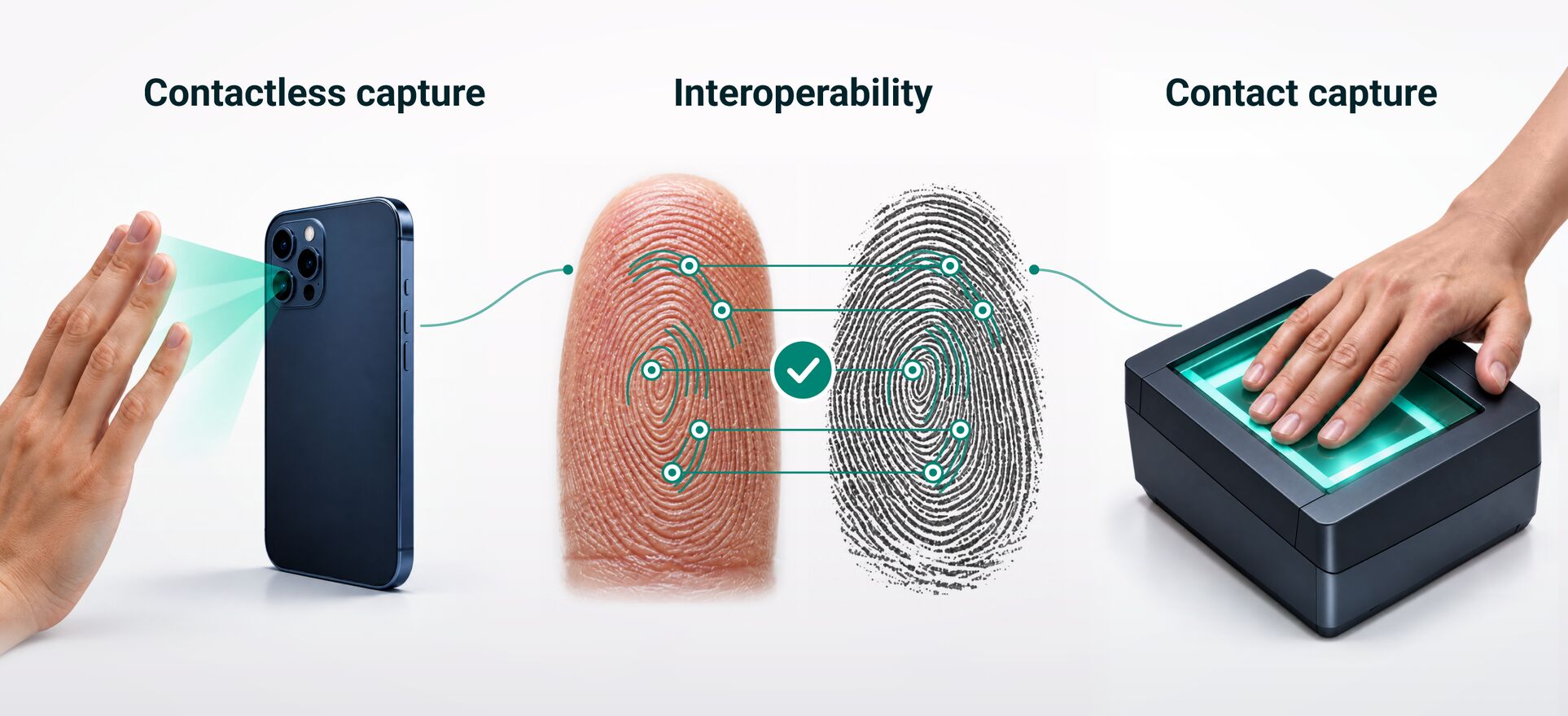
How the SP 500-339 test works
The SP 500-339 test compares fingerprints captured in a contactless way with images of the same fingers taken by a reference device. The reference device must be a live-scan scanner from the FBI Certified Product List that captures fingerprints at 500 ppi. All ten fingers of two volunteers are captured with both devices on the same day, and each contactless image is paired with the reference image of the same finger, which gives 20 image pairs.
Each image pair is analyzed with the NIST Fingerprint Registration and Comparison Tool across measurements such as:
- NFIQ 2 quality;
- ridge orientation;
- corresponding minutiae;
- scale factor.
The capture solution being tested must pass the predicted match score threshold and stay within the allowed scale factor range for every pair submitted. The result is pass or fail; the test does not produce accuracy figures such as error rates. Neurotechnology’s contactless capture technology, running on a standard smartphone camera, met these criteria for all submitted image pairs. The test is designed to show whether contactless images are interoperable with images from contact fingerprint devices.
Why the FastCAP qualification matters
Before the qualification, Neurotechnology had already been developing smartphone-based contactless fingerprint capture (MegaMatcher ID, MegaMatcher Extended SDK), in which fingerprints are obtained from a four-finger slap image taken with a regular smartphone camera. This technology is optimal for identity verification, where contactless fingerprints are used alone or together with face and voice for user authentication in mobile and web applications.
The new, NIST-qualified technology enables contactless biometric data capture that is applicable to a wider range of scenarios, which require collecting contactless fingerprints and comparing them with existing records captured with contact scanners. Fingerprint records in national ID and law enforcement systems have historically been enrolled with contact scanners, so contactless images are useful in these systems only if they can be matched against these records.
Quick contactless capture of all ten fingerprints with a single smartphone is more convenient than using mobile biometric registration kits with dedicated fingerprint scanners. It also allows scaling the number of users in the field: for example, a police officer can capture fingerprints on the spot instead of bringing a person to a precinct for booking. As the fingers do not touch any surface, contactless capture is also more hygienic.
The FastCAP qualification provides an independent reference point for this: NIST qualification testing showed that fingerprints captured with Neurotechnology’s technology on a standard smartphone camera met the SP 500-339 requirements, which compare contactless images with images of the same fingers taken by a contact live-scan device. Anyone who plans to deploy high-quality contactless fingerprint capture can consider choosing a vendor whose technology has met these requirements.
Applications
Contactless fingerprint capture with a smartphone camera enables fingerprint search in large-scale AFIS and multi-biometric systems, such as national ID, voter registration, border control and law enforcement. It can also be used for multi-biometric authentication in mobile and web applications for digital onboarding, banking, payments and government e-services.
See the NIST FastCAP program page and our certificates page for more information.
Inclusion in the NIST FastCAP list of qualified vendors reflects completion of Phase One qualification testing and meeting the requirements defined in NIST SP 500-339. The list is neither a NIST certification nor a ranking, and NIST does not recommend or endorse the listed vendors or their products.


