



Foundation Models for Face Recognition
Adapting with Synthetic Data – What Competition Results Show
Summary: Neurotechnology and the Institute of Data Science and Digital Technologies at Vilnius University participated in the AFMFR competition at IJCB 2026, where their joint face recognition submission ranked first in the Full Data Track. The team achieved the strongest results in the track for accuracy and fairness by fully fine-tuning the CLIP ViT-L/14 model with synthetic training data. The evaluation also showed that the most effective adaptation method depends on how much training data is available.
Foundation models have changed computer vision by learning representations that can be reused for many different tasks. However, adapting a general-purpose model to a specialized biometric task still requires the right training data, objective and optimization method.
To explore these questions, Neurotechnology and the Institute of Data Science and Digital Technologies (DMSTI) at Vilnius University participated in the Competition on Adapting Foundation Models for Face Recognition Using Synthetic Training Data (AFMFR), held at the 2026 International Joint Conference on Biometrics (IJCB 2026). Their joint face recognition submission ranked first in the Full Data Track, leading the evaluation in accuracy and fairness.
What Was the AFMFR Competition Designed to Evaluate?
The competition focused on one main question: how effectively can a general-purpose vision foundation model be adapted to face recognition using synthetic training data?
All teams worked with the same foundation model and training datasets. This setup allowed the organizers to compare different adaptation methods under the same conditions.
How Was the Competition Structured?
All participants were required to adapt the same CLIP ViT-L/14 foundation model. They could use only the synthetic face images supplied by the organizers; external datasets and real face images were not permitted.
The competition included two tracks:
- The Full Data Track provided approximately three million synthetic images representing 35,000 identities and tested large-scale model adaptation.
- The Limited Data Track provided 250,000 images representing 5,000 identities and tested adaptation when less training data was available.
The models were tested on several face recognition benchmarks. These included the smaller LFW, CFP-FP, AgeDB-30, CALFW and CPLFW datasets, the more demanding IJB-B and IJB-C verification datasets and the low-resolution TinyFace identification benchmark. Performance across demographic groups was also evaluated using RFW.
How Did The Team Adapt the Foundation Model?
In the competition paper, the joint submission is called DMSTI-Neurotechnology. The team fully fine-tuned the CLIP ViT-L/14 image encoder, updating all of its parameters for face recognition.
The original CLIP contrastive head was replaced with a Sub-Center ArcFace classification head. This helped the model learn to distinguish facial identities more accurately from the supplied synthetic images.
LoRA-based approaches update only a smaller set of model parameters. Full fine-tuning allows the model to specialize more fully, but it also increases the risk of overfitting when training data is limited.

NLP Technical Lead at Neurotechnology
and a doctoral researcher at Vilnius University
Nakvosas's doctoral research focuses on multimodal foundation models for facial biometrics, connecting his work at Neurotechnology with ongoing research at Vilnius University.
What Did the Evaluation Show?
According to the competition paper, the submission achieved the strongest overall verification performance in the Full Data Track.
Verification Performance
The DMSTI-Neurotechnology submission recorded the best result in the Full Data Track on every verification metric except the two TinyFace identification ranks, where Idiap-BSP led. Each median below is taken across the other five Full Data Track rows reported in the competition paper:
| Metric | DMSTI-Neurotechnology | Best contender | Median |
|---|---|---|---|
| Small-scale benchmarks, average accuracy | 95.51 % | 94.64 % | 93.62 % |
| IJB-B, TAR at FAR 0.1 % | 94.19 % | 92.96 % | 91.18 % |
| IJB-B, TAR at FAR 0.01 % | 89.68 % | 86.58 % | 82.57 % |
| IJB-B, TAR at FAR 0.001 % | 80.52 % | 74.18 % | 69.25 % |
| IJB-C, TAR at FAR 0.1 % | 95.62 % | 94.59 % | 93.26 % |
| IJB-C, TAR at FAR 0.01 % | 92.48 % | 89.83 % | 86.39 % |
| IJB-C, TAR at FAR 0.001 % | 87.42 % | 82.46 % | 76.71 % |
| TinyFace, Rank-1 accuracy | 65.18 % | 65.50 % | 61.88 % |
| TinyFace, Rank-5 accuracy | 70.25 % | 71.14 % | 67.97 % |
Best contender is the highest value recorded by the other five Full Data Track rows, and Median result is the median across those same rows. Higher is better throughout.
At a FAR of 0.001 %, the system is configured so that only 1 out of every 100,000 comparisons with impostors may be incorrectly accepted as a match. The 87.42 % TAR on IJB-C shows that the model continued to recognize legitimate users accurately under this strict requirement.
Accuracy and Fairness Across Demographic Groups
In the RFW evaluation, the submission achieved the highest average accuracy in the Full Data Track, at 91.70 %, and the lowest standard deviation, at 2.33.
The submission also recorded the best result in the Full Data Track for every demographic group, for the average and for the standard deviation. The skewed error ratio is the one fairness measure where other submissions scored better. Each median below is taken across the other five rows reported in the competition paper:
| Metric | DMSTI-Neurotechnology | Best contender | Median |
|---|---|---|---|
| RFW, African subset | 90.82 % | 87.38 % | 84.42 % |
| RFW, Asian subset | 89.78 % | 87.97 % | 84.90 % |
| RFW, Caucasian subset | 95.08 % | 93.25 % | 91.52 % |
| RFW, Indian subset | 91.13 % | 88.97 % | 86.12 % |
| RFW, average accuracy | 91.70 % | 89.39 % | 87.07 % |
| RFW, standard deviation | 2.33 | 2.65 | 3.62 |
| RFW, skewed error ratio | 2.08 | 1.49 * | 1.74 |
* The best contender value for the skewed error ratio, 1.49, belongs to the un-adapted CLIP reference model, not to a competing submission; the best competing submission recorded 1.60.
Best contender is the strongest value recorded by the other five rows in the table, and Median result is the median across those same rows. Higher is better for the four demographic subsets and for the average; for the standard deviation a lower value indicates less variation between groups, and for the skewed error ratio a value closer to 1 indicates less bias.
The average shows the model's overall recognition accuracy across the evaluated demographic groups. A lower standard deviation means that its results varied less between those groups. Based on these two measures, the competition paper identifies DMSTI-Neurotechnology as the leading submission for accuracy and fairness in the Full Data Track. The paper also reports a skewed error ratio, on which other submissions in the track scored closer to 1.
This does not mean that demographic differences have been fully resolved. The study found that performance gaps remain across the evaluated methods, making this an important area for further research.

Head of the Artificial Intelligence Laboratory
at Vilnius University Institute of Data Science and Digital Technologies (DMSTI)
Why Does the Amount of Training Data Matter?
The results showed a clear difference between full fine-tuning and methods that update only part of the model.
Full fine-tuning performed best in the Full Data Track, where approximately three million synthetic images were available. In the Limited Data Track, LoRA-based approaches were more consistent because updating fewer parameters reduced the risk of overfitting.
This means that no single adaptation method is best in every situation. The appropriate choice depends on how much training data is available, how complex the task is and what level of performance is required.
What Are the Main Takeaways?
The AFMFR competition shows that synthetic data can be used to adapt a general-purpose vision foundation model to face recognition without relying on real biometric training images.
The results show that:
- full fine-tuning can deliver the strongest performance when sufficient data is available;
- methods that update fewer parameters may be more stable when data is limited;
- strict low-FAR tests help reveal differences between models in demanding verification scenarios; and
- demographic evaluation should be considered alongside overall accuracy.
For Neurotechnology and the Institute of Data Science and Digital Technologies at Vilnius University, the result also demonstrates how in-depth biometric research can contribute to advances in biometric AI.
References
- Chettaoui, et al. "IJCB-AFMFR 2026: Competition on Adapting Foundation Models for Face Recognition Using Synthetic Training Data." arXiv. July 27, 2026.
- Vilnius University. "VU MIF doktorantas – tarp geriausių dirbtinio intelekto tyrėjų." Vilnius University, Faculty of Mathematics and Informatics. August 17, 2026.
- Neurotechnology. "Benchmarking and Evaluation: What Fuels Biometric Algorithm Accuracy?" Neurotechnology Insights.
Related
Applications
Neurotechnology provides solutions, based on NIST-proven biometric algorithms, which combine high performance with top reliability. These solutions may be applied in various industries, as well as utilized for both civil and forensic applications, which requre properly-tested, accurate technologies.
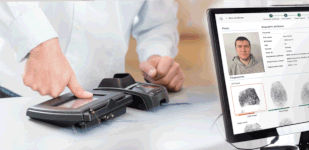
Creates secure identity registers, preventing identity fraud and ensuring accurate distribution of benefits.

Facial recognition and fingerprint scanners verify traveler identity and prevent unauthorized entry.

Biometric technologies are used for criminal identification, investigation and tracking.
help you achieve your biometric data management goals.


