



More Than 25 Years of Independent Biometric Performance Testing
Evaluation Timeline by Biometric Modality
Summary: Every fingerprint, palmprint, face, iris and voice algorithm submitted to NIST, the University of Bologna, UIDAI and IJCB, grouped by modality and listed in order. The timeline covers 50 evaluations and certifications across five biometric modalities from 2000 onwards.
- 26 years of continuous independent testing
- 20 first-place results
- 13 evaluations still active
- 5 modalities evaluated
Independent biometric evaluations have accompanied the development of Neurotechnology's algorithms for more than two decades. Beginning with fingerprint technology in the late 1990s, the company has progressively expanded its biometric portfolio to include face, iris, palm and voice recognition, regularly submitting its algorithms to independent evaluations.
For organizations developing national identity, border control, voter management, law enforcement or forensic systems, independently measured algorithm performance provides an objective basis for technology assessment.
The National Institute of Standards and Technology (NIST), an agency of the U.S. Department of Commerce, conducts a range of internationally recognized evaluations for biometric technologies. These evaluations test algorithms under standardized conditions and provide comparative results across different vendors, datasets and operational scenarios.
While NIST programs form an important part of Neurotechnology's evaluation history, the company has also participated in evaluations organized by other institutions, including the University of Bologna's Biometric System Laboratory, the Unique Identification Authority of India (UIDAI) and international biometric research conferences.
Participation in an evaluation and publication of results do not constitute endorsement by NIST, UIDAI or any other evaluating organization.
Independent Evaluation Across Multiple Biometric Modalities
Neurotechnology has participated in NIST biometric evaluations for over two decades, submitting fingerprint, face and iris recognition algorithms to programs designed to assess identification accuracy and verification performance. This long-term participation has supported continuous algorithm development and has helped validate the technologies used across Neurotechnology's biometric product portfolio.
The company's evaluation history extends beyond NIST; some evaluations, such as FpVTE, PFT II and the earlier FRVT program, have concluded or been replaced. Others, including MINEX III, PFT III, FRIF TE, FRTE, FATE and FVC-onGoing, continue to accept new submissions and publish updated results.
This makes Neurotechnology's evaluation history a continuous process rather than a collection of isolated achievements. Successive algorithm versions have been tested for verification, large-scale identification, interoperability, latent print recognition, biometric image quality and performance under challenging operational conditions.
Fingerprint Recognition: From VeriFinger to Large-Scale and Forensic Identification
Independent evaluations: 2000–Present
Neurotechnology introduced VeriFinger fingerprint recognition technology in 1998. Since then, its fingerprint algorithms have been evaluated in one-to-one verification, one-to-many identification, interoperable template matching, slap fingerprint segmentation and latent fingerprint recognition.
2000 – University of Bologna FVC2000
First place. In the first Fingerprint Verification Competition, Neurotechnology's VeriFinger algorithm achieved the best reliability results among all participants. This marked the beginning of the company's participation in independently organized fingerprint algorithm competitions.
Neurotechnology participated in four editions of the Fingerprint Verification Competition under its former name, Neurotechnologija. The company adopted the name Neurotechnology in April 2008.
Organized by the University of Bologna's Biometric System Laboratory together with other academic biometric research institutions, the competitions evaluated fingerprint verification algorithms using standardized datasets and several measures of recognition accuracy.
2002 – University of Bologna FVC2002
Neurotechnology continued its participation in FVC2002, where its fingerprint recognition algorithm received one silver and two bronze medals across the evaluated datasets and performance measures.
2003 – NIST FpVTE
Neurotechnology's fingerprint evaluation history with NIST dates back to 2003, when the company participated in the Fingerprint Vendor Technology Evaluation (FpVTE) under its former name, Neurotechnologija.
The algorithm showed one of the strongest reliability results in the Middle Scale Test. FpVTE assessed one-to-many fingerprint identification and provided an early independent measure of the technology's suitability for larger biometric databases.
2004 – University of Bologna FVC2004
In FVC2004, Neurotechnology participated with algorithms designed for both general-purpose and resource-constrained applications. VeriFinger received four gold, three silver and two bronze medals in the Open Category. FingerCell, the company's fingerprint technology for embedded and lower-resource platforms, received one gold, six silver and three bronze medals in the Light Category.
The separate categories demonstrated the company's ability to develop fingerprint algorithms for different operational requirements, from full-scale software systems to platforms with more limited computing resources.
2006 – University of Bologna FVC2006
First place. In FVC2006, Neurotechnology's P058 algorithm achieved the highest overall ranking in the Open Category according to Average Zero FMR, a measure of the false rejection rate when no false matches are permitted. The algorithm received four gold, two silver and two bronze medals in this category.
A separate Neurotechnology algorithm ranked second in the Light Category according to Average Zero FMR and received one gold and four bronze medals.
Zero FMR is particularly relevant to high-security biometric applications because it measures recognition performance at an operating point where false acceptance is reduced to zero in the evaluated dataset. At this threshold, stronger algorithms reject fewer legitimate users while maintaining the strict false-match requirement.
Together, the four FVC editions established an early independent performance record for Neurotechnology's fingerprint recognition technology, covering both recognition reliability and performance across different types of fingerprint images and computing environments.
2007 – NIST MINEX Compliance
The company has also participated in the Minutiae Interoperability Exchange (MINEX) evaluations for many years. Neurotechnology was recognized as MINEX compliant in 2007 for both fingerprint template generation and matching.
MINEX focuses on the interoperability of fingerprint templates created and matched by different implementations. This is particularly relevant to systems in which biometric records must remain usable across equipment, software versions or organizations.
2011 – FBI WSQ 3.1 Certification
In 2011, Neurotechnology's WSQ 3.1 implementation received seven FBI certifications, one for each supported computing platform.
2014 – NIST Ongoing MINEX
Neurotechnology placed second in the Ongoing MINEX ranking in 2014.
2015 – NIST FpVTE 2012 Final Report
Neurotechnology's participation continued in FpVTE 2012, where algorithms based on MegaMatcher SDK and MegaMatcher Accelerator were evaluated in one-to-many fingerprint identification scenarios involving single fingers, flat tenprints and more complex tenprint records.
When NIST published the final report in 2015, the company's submission ranked fourth for overall accuracy. In Class C, it was four times more accurate than the second-fastest algorithm in a test involving 5 million tenprints and a 90-second search limit.
2015 – NIST MINEX III: Participation Begins
Neurotechnology began participating in MINEX III in 2015.
MINEX III remains active, meaning that the results may change as participants submit updated algorithms.
2016 – NIST MINEX III: MegaMatcher On Card
Its MegaMatcher On Card algorithm passed MINEX III testing in 2016, followed by further submissions for template generation and matching.
MINEX III is the ongoing evaluation of fingerprint template interoperability for the US PIV program.
2017 – NIST MINEX III: 2017 Results
First for interoperability. In 2017, MegaMatcher SDK fingerprint technology ranked as the most interoperable matcher and the fourth most accurate native template matcher among the MINEX III-compliant matchers evaluated at the time.
2018–2019 – NIST PFT II
Neurotechnology's first participation in the NIST Proprietary Fingerprint Template evaluations dates back to 2018, when the company submitted a fingerprint recognition algorithm to PFT II. Its latest PFT II submission, identified as 4E, ranked among the most accurate algorithms across all 33 experiments. It was also the second fastest during enrollment and the second or third fastest in fingerprint template matching.
PFT II evaluated one-to-one fingerprint verification using proprietary templates and datasets containing up to 120,000 subjects. The program ended in 2019, after which Neurotechnology continued its participation in PFT III.
2018 – NIST MINEX III: 2018 Results
First for interoperability. In 2018, its template generator ranked first for interoperability and its matcher ranked second.
2019 – NIST PFT III: First Results
First place. Neurotechnology entered PFT III in 2019 and took the top position on entry to the program.
The company has submitted successive fingerprint algorithm versions to measure one-to-one matching performance using proprietary templates.
2019 – NIST MINEX III: Template Generator
First place. In 2019, a Neurotechnology submission achieved first place in the template generator category.
2019–Present – NIST SlapSeg III
Active evaluation. Neurotechnology participated in NIST SlapSeg III, which evaluated algorithms that separate individual fingerprints from images containing several fingers captured simultaneously. The published results show tradeoffs between speed and accuracy; the company's submission was neither the fastest nor the most accurate across the four reported categories.
Slap segmentation is important in enrollment systems that capture four-finger slaps, including national ID, voter registration, border control and criminal registration workflows.
2019–Present – University of Bologna FVC-onGoing FV-STD-1.0
First place, active evaluation. In 2020, Neurotechnology's fingerprint extractor and matcher achieved the top result in the FV-STD-1.0 verification benchmark.
The FVC-onGoing platform provides continuing benchmarks for fingerprint verification, ISO-template matching, fingerprint indexing and related biometric tasks. Unlike the earlier FVC competitions, the platform accepts new algorithms on an ongoing basis while keeping the evaluation datasets fixed.
2019–Present – University of Bologna FVC-onGoing FV-HARD-1.0
First place, active evaluation. In 2020, Neurotechnology's fingerprint extractor and matcher achieved the top result in the FV-HARD-1.0 verification benchmark. These tests evaluate one-to-one fingerprint matching, including more difficult image conditions.
2022–2025 – NIST PFT III: Position Defended
First place. Neurotechnology held the top position in NIST PFT evaluations continuously since 2019, confirmed in successive PFT III result releases in 2022, 2023, 2024 and 2025.
October 2023 – NIST MINEX III: Smart-Card Compliance
In October 2023, smart-card submission 020A was confirmed as MINEX III compliant.
Separate smart-card-oriented submissions have also been evaluated for compact template generation and matching. Submission 020A, published in October 2023, is the company's latest smart-card submission and meets the applicable interoperability and accuracy requirements.
2024 – IJCB Latent in the Wild Competition
First place. Neurotechnology participated in the first Latent in the Wild Fingerprint Recognition Competition, held as part of the 2024 IEEE International Joint Conference on Biometrics. The competition evaluated algorithms using latent fingerprints collected from different surfaces under less controlled conditions. One Neurotechnology author contributed to the resulting competition publication.
VeriFinger 13.1 ranked first among three valid submissions from six registered teams. It achieved the highest area under the ROC curve at 0.854 and an equal error rate of 0.228. Its 6.2% failure-to-enroll rate represented a generation-over-generation improvement from the 40.8% rate of the earlier VeriFinger 12.3 baseline; it was not the best failure-to-enroll result in the competition. VeriFinger 13.1 also recorded the lowest computational cost among the submitted solutions, processing a fingerprint pair in 0.78 seconds.
The results demonstrated improvements over the earlier VeriFinger version in enrollment reliability and overall matching performance.
2024 – NIST ELFT: Latent Friction Ridge
First place. Neurotechnology began its publicly documented participation in the NIST Evaluation of Latent Friction Ridge Technology in 2024. In December of that year, the company announced that its first publicly reported ELFT submission had achieved the highest accuracy across most of the evaluated datasets and ranked among the leading algorithms for feature extraction speed.
Latent friction ridge identification covers marks recovered from crime scenes, searched against ten-print and palm databases. ELFT measures performance in both identification and investigation scenarios. Identification tests determine whether a system can return the correct candidate within a specified list, while investigation tests assess candidate-ranking performance.
2025 – UIDAI Biometrics SDK Benchmarking Challenge
First place. In 2025, the Unique Identification Authority of India named Neurotechnology the winner of its Biometrics SDK Benchmarking Challenge for fingerprint recognition. The company's algorithm achieved first place, showing the strongest one-to-one fingerprint matching performance among the solutions selected for the final evaluation.
A notable feature of the challenge was its use of a unique longitudinal fingerprint dataset. The initial samples were collected from children aged 5–10, with corresponding samples captured again after a period of 5–10 years. This allowed UIDAI to evaluate age invariance: the ability of fingerprint verification algorithms to recognize the same individuals as they grow and their fingerprints change over time.
The competition attracted 2,106 applications. Following technical screening and strict security requirements, three submissions were selected for the final evaluation, with Neurotechnology securing first place.
2025–Present – NIST FRIF TE E1N
First place, active evaluation. Neurotechnology participated in the Friction Ridge Image and Features Technology Evaluation Exemplar One-to-Many (FRIF TE E1N), the successor to FpVTE (2012) for large-scale fingerprint identification.
In 2025, its submission ranked first in the majority of NIST FRIF TE E1N test categories, including index-finger and multi-finger identification scenarios.
The Neurotechnology+0106 submission tied for first with one other participant in Class A index-finger identification. In Class B, it ranked second of 11 on individual slaps. The submission achieved zero errors in four experiments.
It ranked second in Class C ten-finger identification. Against 5 million records, median search times were 613 ms for plain ten-finger searches and 560 ms for rolled searches, with zero API timeouts. FRIF TE E1N remains active and evaluates one-to-many identification across different numbers and types of fingerprint images.
2025 – IJCB Second Latent in the Wild Competition
Neurotechnology continued its involvement in the second Latent in the Wild Fingerprint Recognition Competition, held as part of IJCB 2025. The second edition expanded the evaluation from a single recognition task to two separate tracks: latent fingerprint recognition and latent fingerprint quality assessment.
The recognition track evaluated the ability of submitted algorithms to compare latent fingerprints with corresponding reference fingerprints. The new quality assessment track examined whether algorithms could estimate the usability and recognition quality of latent fingerprint images. This is particularly relevant to forensic workflows, where image quality can affect both automated candidate searches and the work of fingerprint examiners.
Neurotechnology co-authored the publication presenting the competition and its results. The company's involvement in consecutive editions provided an opportunity to evaluate the continued development of its fingerprint technology on challenging latent fingerprint data.
[INTERNAL CONFIRMATION REQUIRED: Add Neurotechnology's exact 2025 recognition and quality-assessment placements after checking the complete IJCB paper. Until then, state participation only; the results are published, but the company's placement has not been confirmed from the paywalled paper.]
2025 – NIST SlapSeg III: 2025 Results
In 2025, Neurotechnology's slap fingerprint segmentation algorithm showed off as a top performer, featuring the fastest performance and almost the best accuracy in most categories of the evaluation.
[INTERNAL CONFIRMATION REQUIRED: This statement conflicts with the SlapSeg III entry above, which reports that the submission was neither the fastest nor the most accurate across the four reported categories. Confirm which result release each statement describes before publication.]
2026 – NIST ELFT: 2026 Results
First place, active evaluation. In 2026, the company repeated a top-ranking achievement in ELFT, securing first positions in both identification and investigation scenarios on key datasets.
The submission ranked first in both scenarios on the IARPA N2N and FBI-Provided Solved #1 datasets. It also achieved leading positions in both scenarios on the DoD-Provided Dataset #1 and shared first place on the FBI Laboratory dataset.
2026 – NIST MINEX III: 2026 Results
First place, active evaluation. In 2026, the company continued to lead key MINEX III results. Its algorithms provided the most interoperable PIV Level 1 template generator, the most accurate native Level 2 generator and matcher pair, and the leading interoperable Level 1 generator and matcher pair.
2026 – NIST PFT III: 2026 Results
First place, active evaluation. In the latest PFT III results reviewed in 2026, one Neurotechnology submission achieved the highest accuracy, while another emphasized faster matching and smaller templates, demonstrating the company's ability to refine algorithms for different operational priorities.
PFT III remains an active evaluation.
Palmprint Recognition: Independent Evaluation
Independent evaluations: 2019
Independently benchmarked palmprint recognition.
2019 – University of Bologna FVC-onGoing Palmprint Benchmark
First place. In 2019, Neurotechnology achieved first place in the FVC-onGoing palmprint recognition benchmark.
Face Recognition: From Controlled Images to Operational Scenarios
Independent evaluations: 2015–Present
Neurotechnology has developed its VeriLook face recognition technology for more than 20 years. Independent evaluations have tested the algorithms in one-to-one verification, one-to-many identification, video-based recognition, paperless travel, masked-face recognition, image quality assessment and morphing attack detection.
2015 – NIST Face in Video Evaluation
Neurotechnology's participation in NIST face recognition evaluations includes both earlier and current programs. In 2015, the company submitted an experimental face recognition engine integrated with a face tracker to the Face in Video Evaluation (FIVE), which assessed face recognition of non-cooperating subjects recorded passively.
The submitted algorithm ranked among the top eight most accurate algorithms out of 16 vendors and later contributed to improvements included in VeriLook SDK and MegaMatcher SDK.
2018 – NIST FRVT 1:N Identification
In 2018, Neurotechnology ranked sixth of 40 participants in a 12-million-subject identification test and third of 40 when probe images were captured up to 18 years after enrollment.
2019–2021 – NIST Paperless Travel Evaluation
Neurotechnology algorithms were included in NIST testing for paperless travel and immigration scenarios. Submissions made in 2019 and 2021 were evaluated in simulations involving biometric boarding and airport security galleries.
These tests examined one-to-many identification performance when travelers were compared against galleries created from passport, visa or previous travel images. The evaluation reflects an operational scenario in which face recognition can support passenger processing without repeatedly presenting a physical travel document.
2022 – NIST FRVT Results Release
Neurotechnology also participated in the Face Recognition Vendor Test (FRVT), NIST's earlier face recognition evaluation program.
Its algorithms were evaluated in both one-to-one verification and one-to-many identification. In results published on January 13, 2022, Neurotechnology submissions ranked among the leading algorithms in border-control, kiosk, frontal mugshot and profile mugshot scenarios.
In July 2023, FRVT was split and rebranded into Face Recognition Technology Evaluation (FRTE) and Face Analysis Technology Evaluation (FATE), and Neurotechnology continued participating in these newer evaluation tracks.
November 2023 – NIST FRTE 1:1 Verification
Active evaluation. In the Face Recognition Technology Evaluation (FRTE), Neurotechnology has participated in both core face recognition and specialized face-mask performance testing.
In FRTE 1:1 Verification results published on November 27, 2023, the company's algorithm ranked among the top results in border-control-related scenarios.
The evaluation compares two facial images to determine whether they belong to the same person. Neurotechnology achieved leading accuracy in supervised and unsupervised scenarios involving visa, border and kiosk images.
2023–Present – NIST FRTE 1:N Identification
Active evaluation. In FRTE 1:N Identification, Neurotechnology showed strong performance in both civil identification and investigation-style scenarios, including frontal and profile mugshot matching and border-control comparisons.
In this evaluation, a probe image is searched against a larger facial image gallery. The tested scenarios include frontal-to-frontal and profile-to-frontal mugshot matching, as well as border-control comparisons involving images captured years apart.
December 2023 – NIST FRTE Face Mask Effects
Active evaluation. In FRTE Face Mask Effects results published on December 20, 2023, the algorithm achieved top results for recognizing people wearing face masks or other lower-face occlusions.
The evaluation measures the accuracy cost of lower-face occlusion, which became an operational requirement for many deployments.
2023–Present – NIST FATE Quality
Active evaluation. Neurotechnology has also participated in specialized face analysis evaluations under FATE. In FATE Quality, the company's facial image quality assessment algorithm was tested on challenging photographic conditions.
Quality estimation is important because the accuracy of enrollment and subsequent matching depends strongly on factors such as pose, focus, lighting, resolution and facial visibility.
2023–Present – NIST FATE MORPH
Active evaluation. In FATE MORPH, Neurotechnology participated in the evaluation of face morphing attack detection, an area relevant to document issuance and identity fraud prevention.
The evaluation tests algorithms designed to detect facial images created by combining the features of two or more people. A manipulated photograph of this kind could otherwise be used by more than one person.
December 2025 – iBeta ISO/IEC 30107-3 Level 2 Certification
Neurotechnology's face presentation-attack detection technology received iBeta ISO/IEC 30107-3 Level 2 certification in December 2025. This independent certification is separate from NIST FATE Presentation Attack Detection and should not be presented as participation in that NIST evaluation.
2026 – IJCB AFMFR: Foundation Models on Synthetic Data
First place. In 2026, Neurotechnology participated in the Competition on Adapting Foundation Models for Face Recognition Using Synthetic Training Data (AFMFR), held at the 2026 International Joint Conference on Biometrics (IJCB 2026). The submission was entered as DMSTI-Neurotechnology, reflecting a research collaboration between Neurotechnology and DMSTI, the Institute of Data Science and Digital Technologies at Vilnius University.
DMSTI-Neurotechnology ranked first in the Full Data Track, which evaluated large-scale adaptation of the CLIP ViT-L/14 foundation model using approximately 3 million synthetic face images representing 35,000 identities. The submission used full fine-tuning with a Sub-Center ArcFace classification head and achieved the highest average accuracy across the small-scale benchmarks at 95.51%, while leading on IJB-B and IJB-C across all reported false acceptance rate thresholds.
At the strict IJB-C operating point, the submission recorded an 87.42% true acceptance rate at a false acceptance rate of 10−5, compared with 76.71% for the FRoundation baseline. It also led the RFW evaluation with the highest average accuracy at 91.70% and the lowest standard deviation at 2.33, giving it the strongest results for both accuracy and fairness in the Full Data Track.
Together, these evaluations demonstrate Neurotechnology's continued focus on face recognition performance in both standard verification scenarios and more challenging conditions where facial appearance may be partially obscured.
NIST also analyzed Neurotechnology submissions in NIST IR 8280 (Part 3, December 2019) and in its living FRTE demographics tables. This is an analysis of algorithms submitted to other face-recognition evaluations, not a separate participation track. In a boarding simulation, NIST noted that Neurotechnology-7 was among three algorithms showing the opposite behavior or fairly equitable error rates rather than the broader female-disadvantage pattern.
Iris Recognition: From IREX I to First Place in IREX 10
Independent evaluations: 2009–Present
Neurotechnology's iris recognition algorithms have been evaluated in NIST IREX I, III, IV, IX and 10. The company did not participate in every IREX edition.
2009 – NIST IREX I
Neurotechnology's IREX participation dates back to 2009, when its VeriEye 2.1 iris matching algorithm ranked among the top three for accuracy in NIST IREX I. It was 25–75 times faster than competing algorithms, with templates 3.5–7.5 times smaller.
This established the starting point for Neurotechnology's independently evaluated iris recognition development.
2012–2013 – NIST IREX III
Neurotechnology continued its participation in IREX III, which focused on the performance and interoperability of iris recognition algorithms and compact iris templates.
In 2012, NIST evaluated more than 86 algorithms and variations from nine companies and two universities. Neurotechnology's iris matcher was the second-fastest submission and provided three times higher recognition accuracy than the only faster contender.
2013 – NIST IREX IV
The company's iris technology was subsequently evaluated in IREX IV, which examined iris recognition performance using images collected in operational environments.
NIST IREX IV evaluated 66 iris-recognition prototypes from 12 commercial and academic organizations in a large-scale identification task. In the Class P test using a gallery of 1.6 million single-irises, Neurotechnology's submission was the only one to return results in less than 0.5 seconds without reducing recognition accuracy. Across all tests, its submissions ranked among the top four participants for accuracy.
2016–2017 – NIST IREX IX
Neurotechnology also participated in IREX IX, extending its evaluation history to more recent iris recognition algorithms and datasets.
NIST evaluated 46 iris-recognition algorithms from 13 commercial and research organizations in IREX IX. Neurotechnology's algorithms ranked second for accuracy, while the accelerated version was nearly 50 times faster than any other matcher in the evaluation.
October 2019 – NIST IREX 10: Entry
In October 2019, Neurotechnology joined NIST IREX 10, an ongoing large-scale iris identification evaluation.
IREX 10 accepts submissions continuously and measures one-to-many iris identification at scale.
2023 – NIST IREX 10: 2023 Results
First place. In 2023 Neurotechnology's iris recognition algorithm has been judged by NIST as the most accurate among the participants in the Rank 1 category.
The submitted algorithm outperformed other contenders in both single-eye and two-eye assessments. Also, it showed top results for most performance metrics.
May 2026 – NIST IREX 10: 2026 Results
First place, active evaluation. In May 2026, the company's latest iris recognition algorithm ranked first in all IREX 10 evaluation categories, covering both single-eye and two-eye assessments. The algorithm achieved top results for automated identification and Rank 1 investigation-style accuracy.
The submission achieved the lowest Rank 1 miss rate in both two-eye and single-eye testing, as well as the lowest false negative identification rate at a false positive identification rate of 0.01.
This result also reflects the direction of Neurotechnology's algorithm development: improving not only recognition accuracy, but also matching speed and suitability for large-scale one-to-many identification.
IREX 10 remains an active evaluation.
Voice Recognition: Independent Testing of Speaker Identification
Independent evaluations: 2024
Neurotechnology introduced VeriSpeak speaker recognition technology in 2011. Voiceprints subsequently became part of MegaMatcher SDK, allowing voice recognition to be combined with fingerprint, face and iris modalities.
Neurotechnology's voice-recognition participation is described without ranking claims because NIST SRE rules prohibit advertising a participant's standing and do not permit claims of NIST endorsement.
2024 – NIST Speaker Recognition Evaluation (SRE24)
Neurotechnology participated in the NIST 2024 Speaker Recognition Evaluation, part of an evaluation series conducted by NIST since 1996. SRE24 evaluated automated person detection using conversational telephone speech and audio extracted from video.
The evaluation included audio-only, visual-only and audio-visual tracks, as well as cross-source and cross-language comparisons. It also introduced variable enrollment duration, shorter test segments and recordings containing multiple speakers.
NIST publicly names participating teams but does not link team names to scores, and its evaluation plan restricts promotional claims about standing.
Confirm internally which tracks Neurotechnology entered and which participation details may be published; do not make ranking or endorsement claims.
Why This Matters for Partners
Neurotechnology's NIST evaluation history provides technology partners with an independent view of the company's biometric algorithm development. The company has participated across fingerprint, face, iris and voice programs over many years, with repeated top results in current and retired NIST benchmarks where named comparisons are permitted.
Its broader evaluation history also includes palmprint recognition and programs organized by UIDAI, the University of Bologna and the IEEE International Joint Conference on Biometrics.
This gives partners confidence that Neurotechnology algorithms are tested against independent benchmarks, evaluated across multiple biometric modalities, and continuously improved for practical deployment environments. The evaluation history is especially relevant for systems involving Automated Biometric Identification Systems (ABIS), border control, voter management, law enforcement and national ID.
MINEX compliance is often a mandatory requirement in public tenders in the United States and many other countries.
The value of this history lies not in a single first-place result, but in the range and continuity of testing. Neurotechnology algorithms have been evaluated in one-to-one verification and one-to-many identification using individual fingerprints, tenprints, latent prints, still facial images, video, masked faces, iris images and speech recordings.
The evaluations measure matching accuracy and other operational factors, including interoperability, speed, template size, image quality and segmentation.
Final Remarks
Neurotechnology's long-term participation in independent evaluations reflects the company's commitment to developing accurate, reliable and deployment-ready biometric algorithms.
Its history of independent evaluation began with fingerprint recognition in 2000 and has expanded alongside the company's technology portfolio. Today, its fingerprint, palmprint, face, iris and voice algorithms have been tested across continuing and completed evaluation programs organized by NIST and other institutions.
Across fingerprint, palmprint, face, iris and voice recognition, its technologies have been tested repeatedly in independent evaluation programs and have achieved top results in key categories where named comparisons are permitted.
The company's algorithms are integrated into products and solutions used in national-scale projects, including identity management, border control, voter registration and law enforcement. For organizations seeking a biometric technology partner, this history of independent testing demonstrates both technical maturity and a continued focus on practical, real-world reliability.
NIST SRE rules prohibit advertising a participant's standing, so voice results are stated as participation only. Items marked as unconfirmed await internal confirmation before publication.
Related
Technology Awards and Press Releases
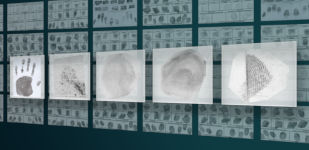
Top results in recent NIST ELFT evaluation with the newest Neurotechnology's latent fingerprint recognition algorithm submission.
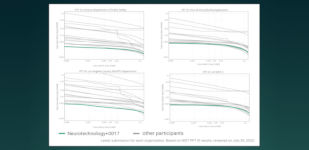
First place in NIST PFT III evaluation. Once again, Neurotechnology's latest proprietary fingerprint verification algorithm has outperformed all the contenders.
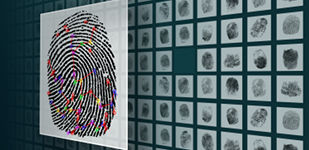
First place overall secured in NIST MINEX III evaluation, in 2023. The template matcher sets a new level of accuracy.
Besides the top achievements, mentioned in the press releases above, Neurotechnology showed excellent results in other biometric technology evaluations and competions:
- SlapSeg III Evaluation – in 2025 Neurotechnology's slap fingerprint segmentation algorithm showed off as a top performer, featuring the fastest performance and almost the best accuracy in most categories of the evaluation.
- IREX 10 – in 2023 Neurotechnology's iris recognition algorithm has been judged by NIST as the most accurate among the participants in the Rank 1 category. The submitted algorithm outperformed other contenders in both single-eye and two-eye assessments. Also, it showed top results for most performance metrics.
- FVC-onGoing – in 2019 Neurotechnology's palmprint matching algorithm has shown the top result at the FVC-onGoing evaluation.
- FRTE 1:1 Verification
- FRTE 1:N Identification
- FRTE Face Mask Effects
- FATE Quality
- FATE MORPH
Applications
Neurotechnology provides solutions, based on NIST-proven biometric algorithms, which combine high performance with top reliability. These solutions may be applied in various industries, as well as utilized for both civil and forensic applications, which requre properly-tested, accurate technologies.
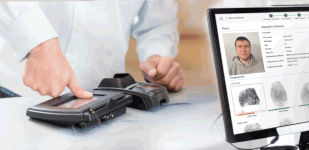
Creates secure identity registers, preventing identity fraud and ensuring accurate distribution of benefits.
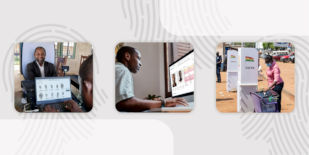
Biometric technologies ensure fair and secure elections due to accurate voter management capabilities.

Facial recognition and fingerprint scanners verify traveler identity and prevent unauthorized entry.

Biometric technologies are used for criminal identification, investigation and tracking.

Biometric authentication enhances security and streamlines transactions by replacing traditional passwords.
help you achieve your biometric data management goals.


