



VeriLook SDK
Face identification for stand-alone or client-server applications
VeriLook facial identification technology is designed for biometric systems developers and integrators. The technology assures system performance and reliability with face liveness detection, simultaneous multiple face recognition and fast face matching in 1-to-1 and 1-to-many modes.
Available as a software development kit that allows development of stand-alone and network-based solutions on Microsoft Windows, Linux, macOS, iOS and Android platforms.
Features and Capabilities
- Millions of algorithm deployments worldwide over the past 22 years.
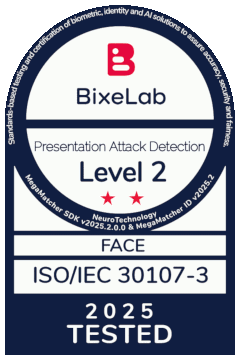
- Face liveness detection is ISO 30107-3 compliant, prevents cheating with photos or printed masks in front of a camera.
- Partially occluded faces (i.e. face mask or respirator) can be recognized.
- Simultaneous multiple face processing in live video and still images.
- Gender classification and age evaluation for each person in an image.
- Webcams or other low cost cameras are suitable for obtaining face images.
- Near-infrared and visible light spectrum facial images can be matched against each other.
- Available as multiplatform SDK that supports multiple programming languages.
- Programming samples and tutorials in C/C++, C#, VB .NET, Java and Python.
- Face Verification system is available for developing large-scale high-security apps.
- Reasonable prices, flexible licensing and free customer support.
The VeriLook algorithm implements advanced face localization, enrollment and matching using robust digital image processing algorithms, which are based on deep neural networks:
- Simultaneous multiple face processing. VeriLook 2025.2 performs fast and accurate detection of multiple faces in live video streams and still images. All faces on the current frame are detected in 0.01 - 0.86 seconds depending on selected values for face roll and yaw tolerances, and face detection accuracy. After detection, a set of features is extracted from each face into a template in 0.6 seconds. See technical specifications for more details.
- Partially occluded faces recognition. Persons wearing protective facemasks (i.e. surgical, cloth or respirators) can be recognized without separate enrollment. See technical specifications for more details.
- Gender classification. Optionally, gender can be determined for each person on the image with predefined degree of accuracy during the template extraction.
-
Face liveness detection.
Certified algorithm for face liveness checkA conventional face identification system can be tricked by presenting a photo or wearing a mask with a printed face of another person. VeriLook is able to prevent this kind of security breach by determining whether a face in a video stream or single frame is "live" or somehow faked. The liveness detection can be performed in passive mode, when the engine evaluates certain facial features, and in active mode, when the engine evaluates user's response to perform actions like blinking or head movements. See recommendations for face liveness detection for more details.
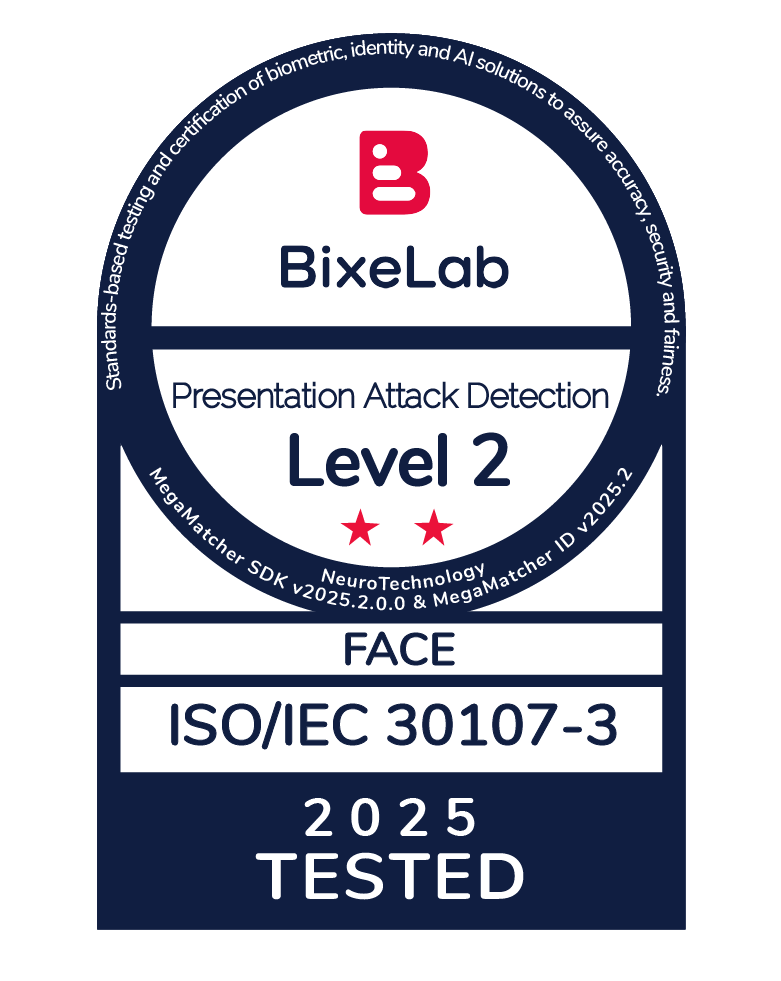
Letter of confirmation from BixeLab - Face morph detection. A specialized module can assess whether a face image is genuine or has been altered by blending features from two or more individuals. This verification helps prevent various security threats, such as document fraud or attempts to bypass biometric access control systems.
- Facial feature points. The points can be optionally extracted as a set of their coordinates during face template extraction. Each of the 68 points has a fixed sequence number (i.e. number 31 always corresponds to nose tip).
- Facial attributes. VeriLook can be configured to detect certain attributes during the face extraction – smile, open-mouth, closed-eyes, glasses, dark-glasses, beard and mustache.
- Age estimation. VeriLook can optionally estimate person's age by analyzing the detected face in the image.
- Face image quality determination. A quality threshold can be used during face enrollment to ensure that only the best quality face template will be stored into database.
- Tolerance to face position. VeriLook allows for 360 degrees of head roll. Head pitch can be up to 15 degrees in each direction from the frontal position. Head yaw can be up to 90 degrees in each direction from the frontal position. See technical specifications for more details.
- Multiple samples of the same face. Biometric template record can contain multiple face samples belonging to the same person. These samples can be enrolled from different sources and at different times, thus allowing improvement in user experience during matching. For example a person might be enrolled with and without beard or mustache, etc.
- Identification capability. VeriLook functions can be used in 1-to-1 matching (verification), as well as 1-to-many mode (identification). The VeriLook 2025.2 face template matching algorithm can compare up to 40,000 faces per second on a PC. See technical specifications for more details.
- Small face features template. A face features template can be as small as 322 bytes, thus VeriLook-based applications can handle large face databases and provide high matching reliability. See technical specifications for more details.
- Near-infrared and visible light spectrum face images can be used for face recognition. VeriLook algorithm is able to match faces, which were captured in near-infrared spectrum, against faces, captured in visible light. See the testing results for details.


